

11·
2 days agoA handful of people use Roblox to make milllions - if they pay out $1.5B total, and the biggest 1000 developers average $1.3M, then the entire rest of their 3.5 million developers average $60.
They claim 150M daily users.
A handful of people use Roblox to make milllions - if they pay out $1.5B total, and the biggest 1000 developers average $1.3M, then the entire rest of their 3.5 million developers average $60.
They claim 150M daily users.

On the one hand, that reads like a lot of messages written by abusive parents to (mostly) blameless children. On the other, this one is directed at Pete Hegseth.
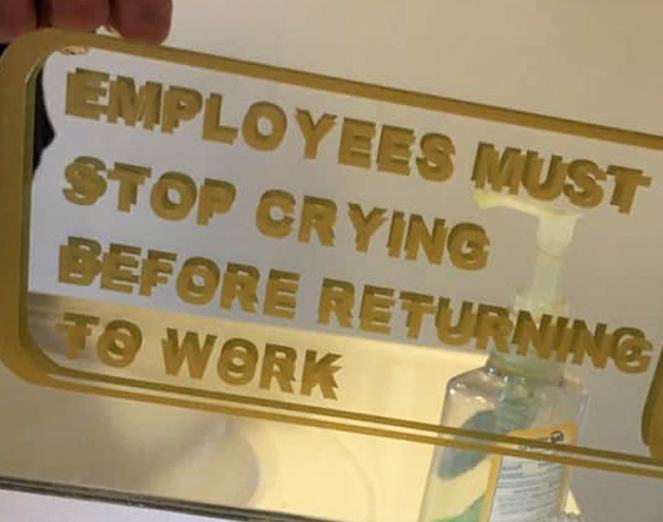
And here’s me, reading that tech companies are feeding their employees tabasco and wondering just what that’s supposed to do.

They haven’t chosen the next democrat yet. Now is the time to be screaming that no one wants another corporate democrat, but we sure would love someone to come in and clean house and support working people.

In the game, you have to improve your properties to charge more rent. In reality, the monopoly can reduce quality and raise price at the same time.

People don’t use free & open source alternatives because their advertising is shit, and most people have never heard of the alternatives to Facebook, Twitter, and Spotify.
Labor may be the source of your power, but consumption is how you fritter it away. Trade your labor for subscription plans, little conveniences that prop up the oligarchs, big luxuries like fancy car or home, and you lose your ability to withhold your labor in safety.
Withholding your labor only works if you can recruit a lot of like-minded people, each with their own safe ability to withhold labor. We can get there eventually, but you have to start with yourself.
Pretty sure he just thinks he, personally, gets all the tariff money, because he’s incapable of distinguishing between himself and the organizations he runs.

She is still a true believer - she loves the racism, the sexism, the LGBT-phobia, the tax breaks for rich, the church-instead-of-school, the two-tiered justice system… She’s just also still on the Q-anon anti-pedophile train, where the rest of MAGA leadership is willing to overlook a few rapes if they get all the other stuff.

You can start by experimenting on your current computer. Install docker, get some service that sounds interesting, and just access it on localhost. You’ll miss out on anything the service does overnight or downtime, and you won’t be able to access it from off-site, but it’s a fine way to wet your toes and see how it goes.
Docker: https://docs.docker.com/desktop/setup/install/windows-install/
Photo library: https://docs.immich.app/install/docker-compose/
Some maintainers even provide handy windows installers
Media library: https://jellyfin.org/docs/general/installation/windows
They can still reject the application. This just means they will go through the motions of looking at it first.
My nephew has a new baby. Her parents are constantly waving their phones in her face; sending pics back and forth; generally doing ‘millenial things’ with their phones when not actively attending the baby. Then proceed to get all freaked out when the baby expresses interest or curiosity in the phone.
Kids mimic their parents behavior and interests. If you want kids with healthy internet use, you have to have parents model healthy internet use.
From @[email protected] source, the 10%/90% ratio went from 1.55 in 1989 to 2.14 in 2025.
Consistent with their criticism of choosing the top 10% vs the top 1-or-fewer %, the 1%/99% ratio went from 30% to 46%. The 1%/90% ratio went from 58% to 99, and the (10-1)%/90% from 97% to 114%.
ed: Initially did this without noticing that the default view of the Fed data only showed 2010-2025. Over that range, the (10-1)% have actually lost wealth to the 1%. Over the 1989-2025 window, the (10-1)% have gained, but not nearly the pace of the 1%
The ‘mostly safe 4% rule’ actually includes inflation. It’s based on the assumption that assets are invested in a mix of broad stock market and treasury bonds, and allows the retireee to increase their annual spending by inflation, It usually results in the retiree dying with substantially more wealth (inflation adjusted) than they started out with. The stock market is a natural inflation hedge and, in this day of multinational conglomerates, a currency hedge.
The trouble with living in a panopticon is that becomes suspicious to not be on a list.
I have a n ESP32 with a thermocouple stuffed down my (gas) oven chimney, so I can tell what temperature it actually is (about 40°F/20°C cooler than the dial).
I have one plugged into an addressable LED matrix, which has yet to get mounted, but will eventually be a closet/dressing light. There’s a few places where I’d like a ‘normal’ warm white light, with the option to switch to a blinding daylight for chores, and maybe a low-light, colorful animated nightlight.
I have a Pi-0w reading temp/humidity/CO2 in a grow tent that’s a good candidate for ESP32-ification. I have an air quality sensor plugged directly into a Home Assistant server that could go on ESP32 if I wanted it in a different location. Humidity in the bathroom, with a controller for the bathroom fan is another good candidate.
If I can come up with a good way to put them on battery, with a 6-12 month lifetime, then temperature in the attic, and on the input/output sides of the HVAC would be useful.
I only one I know about https://socprime.com/blog/cve-2025-27840-vulnerability-in-esp32-bluetooth-chips/ which is a bluetooth thing, presumably meaning that you’d have to be in bluetooth range to exploit it.
My paranoid concern is that I’m going to buy these $2 ESP32 boards from some unknowable Chinese company, and how could I know if there’s an extra, malicious supervisor element added. So, my ESP32 devices live in the ‘untrusted’ VLAN. They could, theoretically, discover each other and send their sensor data to some nefarious broker, but they don’t have microphones or cameras. I don’t even see how they could get enough information to discover my physical address, without cooperation from my ISP.
I was really intimidated by ESP32. Liked RPi, back in the 3b days, because I could comfortably sit in the python interpreter, play with sensor interfaces, and get immediate feedback of what & where I screwed up. Familiarity led me to RPi4 for libreelec and 0w for more sensors.
Recently took the plunge on some ESP32s, though, and, just…wow. I mean, I’m going through esphome, but every sensor and control I’ve checked is just a couple of lines of YAML away. And low enough power that I’m starting to think about batteries. ESP32 is still pretty intimidating for noobs, but the ecosystem that’s grown up around it is fantastic once you get over that hump.

To me, the nonstandard port is mostly nice for reducing log spam from scripts. The risk is that using a nonstandard port lulls one into a false sense of security and overlook good sshd practices. Good sshd practices will prevent the script-kiddies just as well as the non-standard port, while a non-standard port will not challenge a targeted attack. And, if you interact with multiple servers, it can be inconvenient to remember a different port for each one.