Seeing the up votes and down votes in this thread, I realize this is an unpopular “opinion” but the flowers didn’t necessarily evolve to look like hummingbirds specifically. That many people see it as looking hummingbird-like is more a reflection of the human mind’s ability to find patterns and connections even when they don’t exist. It’s interesting and pretty for sure, and definitely a curiosity.
Same thing for the “monkey orchid”. You see a monkey because the flowers are photographed at an unnatural angle and forced perspective, the photos online where the effect is most visible are the ones with lots of compression artifacts and generally poor quality, and because of the power of suggestion. If you saw these in person (without prior context of the photos), there’s a good chance you wouldn’t even notice the face-like visage unless pointed out.
On the other hand, the “bee orchids” actually are an example where it seems that the flowers have evolved in a way that specifically mimics the appearance of bees (and wasps). These flowers mostly attract male bees and wasps who confuse them for lovely lady bees and wasps and try to mate with the flowers. In the process, they pick up a pollen sac / pollinia, and if all goes well they end up pollinating the flower (or move on to pollinate another one).
There are examples of biological mimicry that result from natural selection pressures, leading to the evolution of such an organism.
Heres one thought experiment on why this plant’s evolution to mimic a hummingbird is not that unlikely (keeping in mind that mutations are random, and whatever ends up succeeding due to natural selection pressures doesn’t necessarily imply a deterministic process):
-hummingbirds select to drink from plants that other hummingbirds visit, leading to
-plant reproducing more because hummingbirds drinking from one flower to another helps with pollination, leading to
-plant evolving to look like other hummingbirds drinking from it so real hummingbirds drink from it
We can’t know for sure without doing research of course, but we have enough understanding of natural selection and evolutionary processes to reason about such mechanisms for existing organisms :)
Edit: doesn’t matter if plant native to Australia.You know continents were joined at one point, and evolution takes hundreds or millions of years at times. Also, I don’t mind being mistaken for chat gpt, I am shit posting anyway lol.
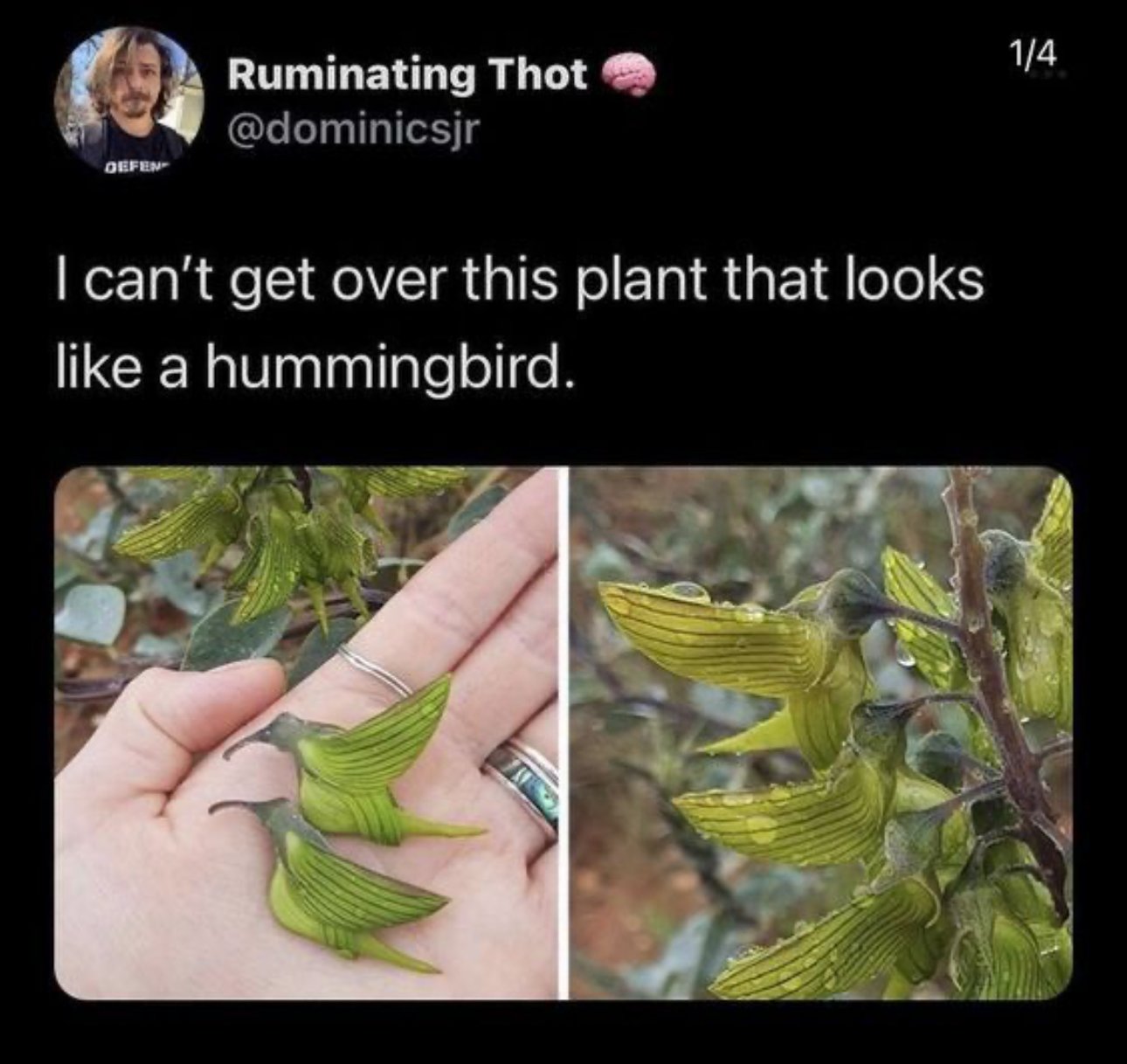
The appearance of the flowers of Crotalaria cunninghamii has been debated whether it resembles a bird by natural selection or if it is due to chance. The debate is whether the flowers are bird shaped to ward off unwanted predators or to attract certain pollinators, known as Batesian mimicry, or if it is just by chance that they look like birds and humans have associated the shape of the flower with a bird, known as pareidolia. Michael Whitehead from the University of Melbourne stated that the shape of the flowers are consistent with bird pollination, with its large flowers and long keel on its petals. This makes sense because the predominant pollinators of Crotalaria cunninghamii are nectivorous birds and bees.[7] There are a large number of plants with flowers that look like animals, such as the Dracula simia (monkey orchid) that looks like a monkey or the Phalaenopsis (Moth Orchid) that looks like a moth.[8] These plants have the same debate surrounding their unique appearance.
Wonderful. Absolutely wonderful to go on the internet and see some good fuckin plant facts. I couldn’t be happier with this place.
Another cool thing about the plant from that page:
In a paper written by Ds Davidson, published in 1947, it was noted that the Warnman people, an Aboriginal Australian group, used Crotalaria cunninghamii to make canvas shoes. The Warnman people primarily lived in the Gibson Desert and used Crotalaria cunninghamii fibre shoes to protect their feet from the hot sand and rugged stony desert ground. The way the fibre was constructed was by peeling off the soft bark and then tying the smaller fibres together and tying them around your feet.[11] The Indigenous people of the Little Sandy Desert also used the plant in this way, as well as for belts to hang food, such as goanna, from.[12]
The most amazing thing about this is that the plant has never seen a hummingbird.
Think about it. The plant has no eyes nor the ability to change its own leaves. What must have happened? Maybe an ancestor had leaves that randomly, vaguely resembled a bird? Perhaps the descendants that happened to look more like hummingbirds were then pollinated more often than the rest?
Nature is so fucking crazy and I love it.
The plant has no eyes nor the ability to change its own leaves.
You should probably google Boquila trifoliolata.
But yes, it’s impressive if it never met anything that looks like a hummingbird.
Holy shit, thanks for sharing! I think it’s impressive in either case.
For anyone else, here’s an article I found about it: https://www.vox.com/down-to-earth/2022/11/30/23473062/plant-mimicry-boquila-trifoliolata
This is species of spider that has evolved to look like an ant. They do this so they can infiltrate the ant’s nests and get a free meal by just eating the ants food.
The thing is the ants blind so there was no point looking the same as they wouldn’t have been able to tell anyway.
Can’t they feel the shape?
It should, however, emit some pheromone, as the ants use that to identify each other…